The earlobes frame the lower lateral facial contours and serve as the traditional foundation for jewelry and personal adornment. Composed solely of pliable skin and soft subcutaneous adipose tissue without internal structural cartilage, the lobule is anatomically vulnerable to mechanical wear, progressive stretching, and abrupt traction trauma. Heavy dangling earrings worn over decades, sudden accidental tears from snagged clothing, or intentional stretching with ear tunnel gauges often produce severe deformities.
These range from elongated, slit-like piercing tracts to completely bifurcated (split) lobes. Because an open or split earlobe defect is fully lined by mature healed skin (epithelium), the separated halves can never heal together naturally without surgical intervention. In modern reconstructive and facial aesthetic plastic surgery, an earlobe correction (clinically known as a lobuloplasty) provides the definitive, minor surgical intervention to restore a smooth, natural rounded ear contour and allow future re-piercing.
Table of Content
What Is Earlobe Correction?
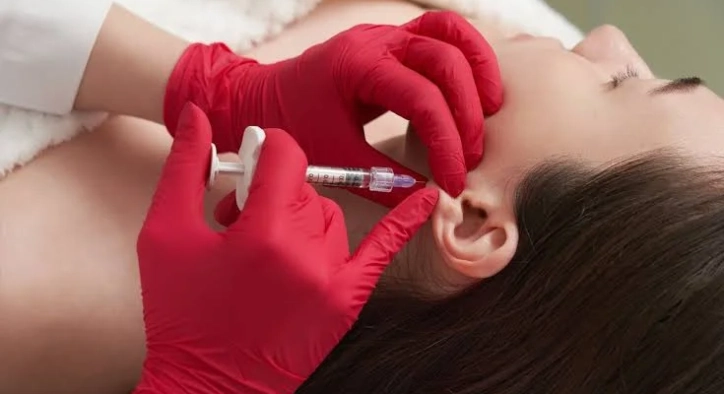
To establish a clear medical foundation, let us examine what happens during split earlobe correction from a plastic surgical perspective. Clinically categorized as a lobuloplasty or earlobe reconstruction, this is an outpatient micro-procedure performed under local infiltration anesthesia that typically takes 20 to 40 minutes per earlobe.
THE LOBULOPLASTY MICROSURGICAL SEQUENCE:
[Local Infiltration Anesthesia] ➡️ [De-Epithelialization of Internal Cleft Tract] ➡️ [Straight-Line, Z-Plasty, or L-Flap Incision Geometry] ➡️ [Multi-Layer Deep Dermal Anchoring] ➡️ [Everted Skin Suture Approximation]
The Critical Step: De-Epithelialization
The core biological reason a split earlobe cannot simply be stitched shut is that the cleft is lined with outer skin. To achieve permanent biological fusion, the plastic surgeon must carefully excise (freshen) a narrow 1-millimeter border of epithelial skin along the inner margins of the split. Once healthy raw subcutaneous vascular tissue is exposed on both sides, the halves are meticulously aligned and sutured in multiple layers to restore natural thickness.
Surgical Techniques: Simple Excision vs. Z-Plasty vs. Gauge Flap Repair
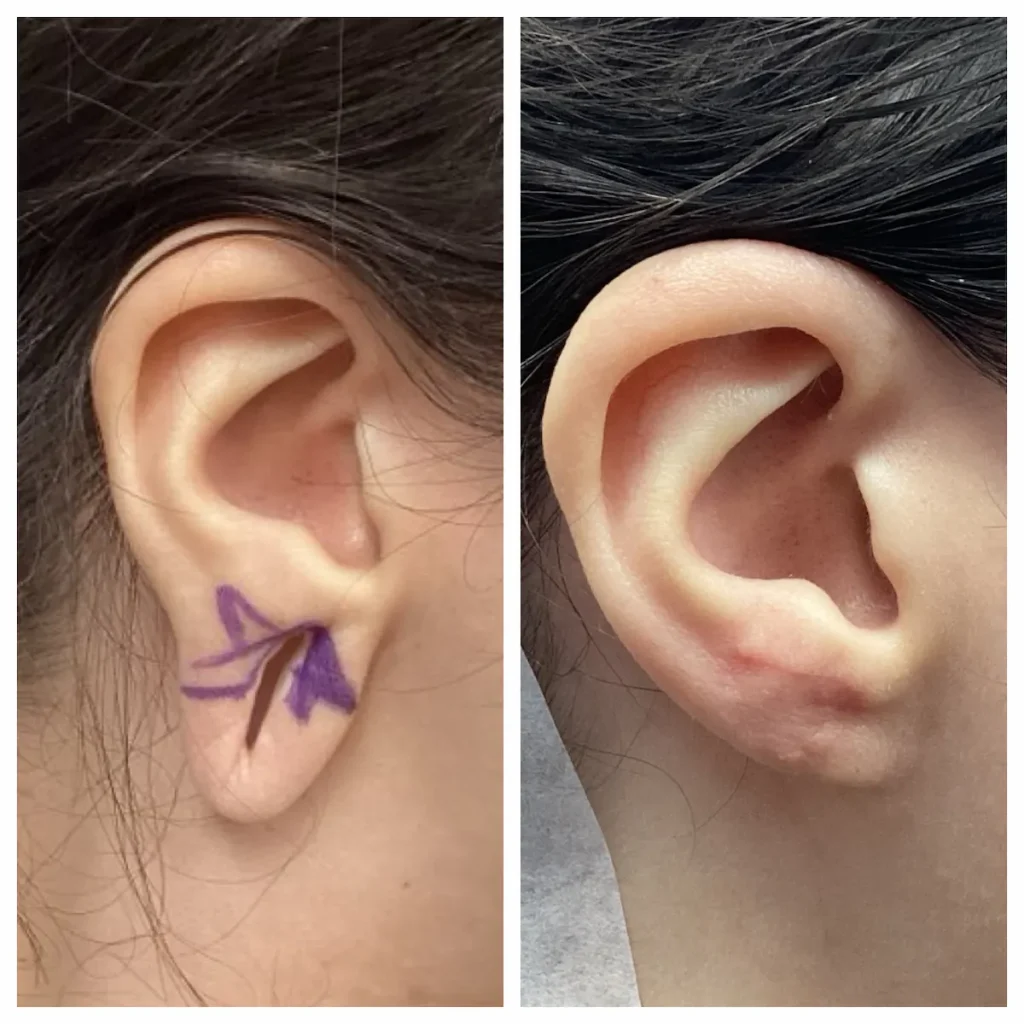
Choosing the appropriate technique for earlobe correction surgery depends directly on the mechanical classification of the defect.
SURGICAL CLASSIFICATION & METHODOLOGIES:
- Partial Cleft (Stretched Slit): Linear excision of internal skin tract; layered closure; preserves natural inferior rim.
- Complete Split (Bifurcated Lobe): Z-plasty or stepped flap repair; breaks up scar line; eliminates inferior notch deformity.
- Stretched Gauge / Tunnel Defect: Redundant skin reduction; purse-string or rotation flaps; rebuilds lobular volume.
1. Linear Repair with Stepped Inset
For partial tears or simple bifurcations, the margins are de-epithelialized and re-approximated. However, closing a complete split in a pure straight line often leads to scar contraction over time, creating a small notch at the bottom of the earlobe (the dreaded "notching deformity"). Experienced surgeons incorporate a tiny step or flap at the inferior border to maintain a continuous, curved perimeter.
2. Z-Plasty and Geometric Flaps
To counteract contracture in larger tears, surgeons use a Z-plasty. By transposing two small triangular flaps along the lower margin, the vertical scar vector is redirected into horizontal and oblique angles. This redistributes tension along natural skin tension lines, producing a flat, pliable scar that resists future tearing.
3. Gauge and Flesh Tunnel Reconstruction
Patients with enlarged ear tunnels from tribal-style gauges present with stretched, thinned, hanging loops of skin. Correction requires tailored lobule reduction. The surgeon removes the inner circle of stretched skin, reshapes the floppy outer rim, and rotates local tissue flaps to rebuild a compact, natural lobule.
Visual Proof: Earlobe Correction Before and After Transformations
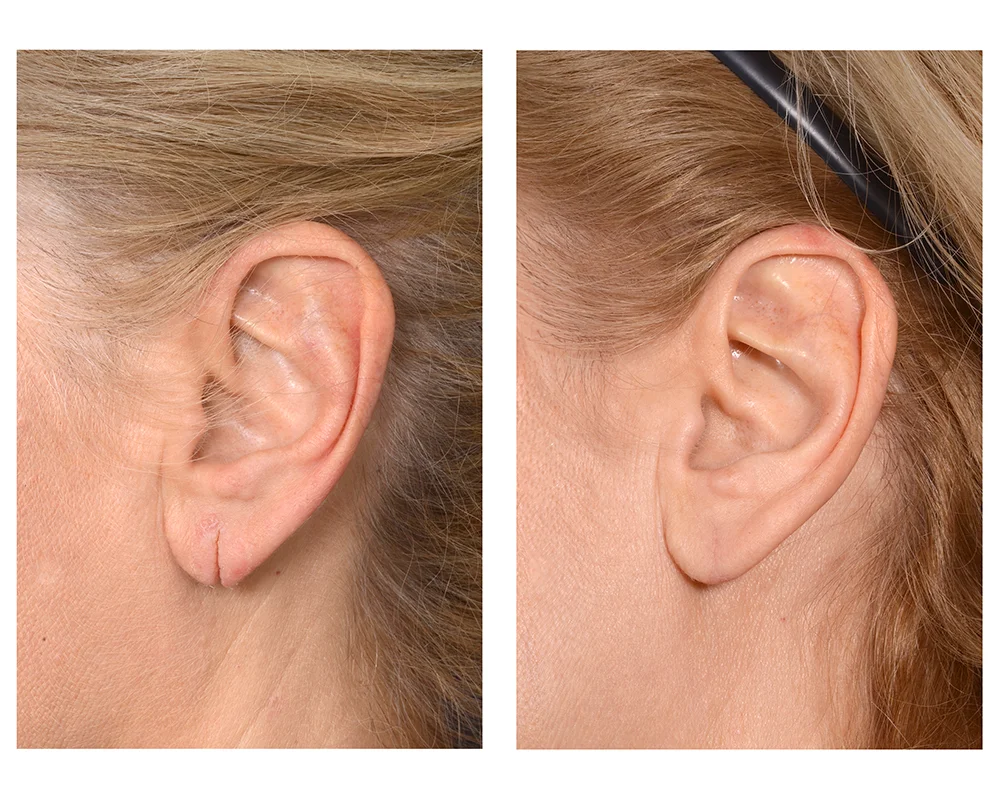
Reviewing unedited clinical cases demonstrates how meticulous micro-suturing transforms stretched or torn lobules into natural contours:
The final result replaces split, drooping tissue with a smooth, symmetrical earlobe that harmonizes with the natural curvature of the jawline and outer ear.
Healing Roadmap and Re-Piercing Protocols
Understanding post-operative healing ensures that the reconstructed earlobe achieves structural tensile strength before any new earrings are introduced.
THE POST-OPERATIVE RECOVERY TIMELINE:
- - Days 1 to 3: Acute Healing ➡️ Mild swelling; tiny adhesive dressing strips; keep ears dry for 48 hours.
- Days 7 to 10: Suture Removal ➡️ Micro-sutures removed in clinic; return to gym workouts and swimming.
- Weeks 3 to 6: Scar Maturation ➡️ Redness softens into a faint line; gentle massage with silicone scar gel.
- Months 2 to 3: Re-Piercing Milestone ➡️ Lobule fully revascularized; safe to re-pierce strictly away from the scar line.
The Golden Rules of Re-Piercing
- Wait at Least 8 to 12 Weeks: Tissues must undergo complete collagen maturation before undergoing the trauma of a needle.
- Avoid Piercing the Scar Line: Never place a new piercing directly inside the healing scar tissue. Because scar tissue is less elastic and less vascular than normal skin, it tears more easily under mechanical weight. Place new holes at least 2 to 3 millimeters to the side of the original scar.
- Start with Small Studs: Wear light titanium or solid gold studs continuously for the first six months. Avoid heavy hanging hoops or chandelier earrings that apply downward traction.
Cost Determinants: Understanding Procedure Pricing Variables
When evaluating lobular reconstruction, prospective patients should note that pricing varies depending on clinical complexity rather than a single fixed rate. The overall earlobe correction surgery cost is determined by several clinical and logistical variables:
- Unilateral vs. Bilateral Correction: Treating an isolated single torn earlobe involves different operative time and suture materials compared to bilateral reconstruction of both ears.
- Defect Complexity (Tear vs. Stretched Gauge): A simple split tear repair requires fewer surgical steps than an extensive gauge reconstruction requiring rotational tissue flaps and excess skin volume reduction.
- Anesthesia & Operating Environment: Earlobe surgery is routinely performed under local anesthesia in an outpatient clinical suite. If a patient elects twilight sedation or combines the repair with a facelift or rhinoplasty under general anesthesia, facility overhead changes.
- Combined Facial Procedures: Earlobe correction is frequently paired with otoplasty (ear pinning), facial fat grafting, or blepharoplasty, optimizing shared clinical time.
- Comprehensive Logistics: All-inclusive medical packages in Turkey incorporating VIP airport transfers, hotel accommodations, initial surgical supplies, and follow-up care create variable pricing tiers.
Because surgical plans are customized to individual tissue dimensions, exact quotations are established following a personalized clinical evaluation. The matrix below outlines relative regional price structures for 2026:
Healthcare Destination / Region | Cost Structure & Price Variability | Relative Price Level | Typical Package Framework |
United States (USA) | Variable per ear by surgeon & city | High | Procedure Only (Consultation & Suture Checks Extra) |
United Kingdom (UK) | Variable per lobe by private clinic | High | Procedure Only (Follow-Up Visits Invoiced Separately) |
Germany / Switzerland | Variable by medical fee scale (GOÄ) | Moderate to High | Procedure Only (Materials & Checks Billed Separately) |
Stamboul (Turkey) | Dynamic Custom Package | High Value / Accessible | Comprehensive (Bilateral Option, Transfers & Follow-Up) |
Frequently Asked Questions (FAQ)
Can a split earlobe heal back together on its own without surgery?
No. Once an earring hole has torn through, the edges of the split are covered by healed, epithelialized skin. Because two layers of intact skin cannot fuse together biologically, the earlobe cannot close on its own. A minor surgical procedure is required to remove the skin lining the cleft, exposing raw tissue that can then heal together permanently.
Is earlobe correction surgery painful?
No. The procedure is performed under local anesthesia. Patients feel a mild pinch and slight sting for a few seconds while the numbing fluid is injected into the lobule. Throughout the actual repair, the ear is completely numb, and you feel no pain whatsoever. Post-operative discomfort is very mild, often described as a faint throbbing, and is easily controlled with simple paracetamol or ibuprofen for twenty-four hours.
Will there be a noticeable scar after my earlobe is repaired?
The incision heals into a fine, faint vertical or zig-zag line. Initially, the scar appears slightly pink, but over three to six months it fades to match your natural skin color. Because the earlobe is small and sits on the side of the head, the healed mark is generally imperceptible in normal social interactions.
Can I wear clip-on earrings while my earlobes are healing?
You should avoid wearing clip-on or magnetic earrings for at least six to eight weeks after surgery. Clip-on earrings exert direct compressive pressure on the newly repaired lobule, which can compromise capillary blood flow, flatten the tissue, or cause wound breakdown along the internal suture line.
Why do earlobe correction prices vary between different patients?
Pricing varies because the surgical plan is tailored to the defect. A straightforward partial cleft on one ear involves different surgical time and technique than rebuilding both ears following large gauge stretching, which requires custom flap design and skin excision.
Über den Autor