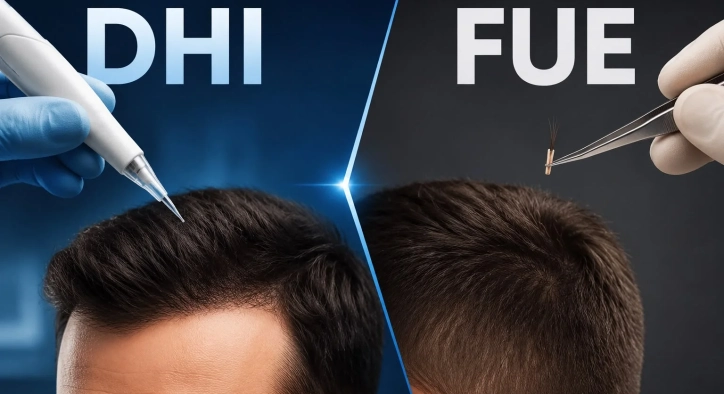
The evolution of hair restoration technology has provided patients with highly advanced, micro-invasive methodologies that deliver natural-looking results. When exploring surgical options to address androgenetic alopecia or structural hairline recession, individuals encounter two dominant surgical techniques: Follicular Unit Extraction (FUE hair transplant) and Direct Hair Implantation (DHI hair restoration). Deciding which methodology aligns with your physiological needs requires an analysis of extraction mechanics, implantation protocols, and tissue healing dynamics.
At Stamboul Clinic, we prioritize personalized diagnostic design over a one-size-fits-all approach. Evaluating FUE vs. DHI hair transplant workflows involves looking closely at how individual follicular grafts are harvested from the donor zone and placed into the recipient thinning areas. This guide provides a balanced comparison, evaluating dhi vs fue results, detailing specific procedural limitations, analyzing the post-operative recovery timeline, and answering the question: Is dhi better than FUE for hair transplant?
Table of Content
- Understanding the Methodologies: How Does DHI Compare to FUE?
- Evaluating Implantation Mechanics: Is DHI Better Than FUE for Hair Transplant?
- Procedural Limitations: What Are the Disadvantages of DHI?
- The Post-Operative Journey: Would I Look Normal 10 Days After FUE?
- Comparative Overview: Long-Term Growth and Structural Results
- The Stamboul Advantage: Precision Hair Restoration in Istanbul
- Frequently Asked Questions (FAQ)
Understanding the Methodologies: How Does DHI Compare to FUE?
To establish a clear medical foundation, patients first need an answer to the core question: How does dhi compare to FUE? At their structural foundation, both methodologies share the exact same initial extraction protocol. Individual follicular units are harvested from the back and sides of the scalp (the donor area) using a specialized motorized micro-punch tool.
The divergence occurs during the canal creation and graft implantation phase.
THE PROCEDURAL STEP COMPARISON:
[FUE Workflow]: Harvest Grafts ➡️ Separate Incision Phase (Create Canals) ➡️ Manual Implantation with Forceps
[DHI Workflow]: Harvest Grafts ➡️ Load into Choi Implanter Pen ➡️ Simultaneous Canal Creation & Implantation
In a standard FUE procedure, the surgeon opens microscopic incisions across the recipient area using sapphire blades to create reception canals. Once this phase is complete, the harvested grafts are manually placed into these channels using precise forceps.
Conversely, the DHI method completely bypasses the separate channel-opening phase. Instead, the harvested follicular units are loaded into a specialized mechanical device called a Choi Implanter Pen. The hollow needle of the pen punctures the scalp tissue and instantly deposits the loaded graft in a single, fluid motion.
Evaluating Implantation Mechanics: Is DHI Better Than FUE for Hair Transplant?
When determining the best hair transplant method for a specific scalp, patients frequently ask: Is dhi better than FUE for hair transplant? From a clinical perspective, DHI is not inherently superior to FUE across all situations; rather, it is highly specialized for specific patterns of hair thinning.
CLINICAL MATCHING MATRIX:
- [FUE Hair Transplant]: Ideal for major bald areas, high graft volumes (3,500+ grafts), and cost optimization.
- [DHI Hair Restoration]: Ideal for localized density enhancement, crown filling, and unshaven procedures.
DHI provides notable advantages for localized density restoration. Because the Choi Implanter Pen encapsulates the fragile hair graft within a protective hollow steel needle during placement, the mechanical tissue of the bulb is shielded from manual forceps friction. This can improve graft survival rates in specific tissue environments.
Additionally, the DHI tool allows surgeons to control the depth, angle, and direction of the hair placement with high precision, making it an excellent choice for lowering a feminine hairline or thickening spaces between existing hairs without damaging nearby roots.
Procedural Limitations: What Are the Disadvantages of DHI?
While the single-step implantation process offers distinct benefits, an honest clinical review must also address the question: What are the disadvantages of dhi? The technique presents specific operational limitations that prevent it from being the ideal choice for every degree of hair loss.
- Lower Graft Volume Capacity per Session: The loading and placing process of DHI requires significant time. Each graft must be manually loaded into a Choi pen by a specialized technician before the surgeon can place it. Because of this structural time constraint, DHI is generally capped at 2,500 to 3,000 grafts per day, making it less suitable for advanced hair loss stages requiring massive graft volumes.
- Elevated Pricing Tiers: Because the DHI method requires a larger team of clinical assistants to load multiple single-use Choi pens simultaneously, operational costs are higher, reflecting the elevated overall cost of the procedure.
- Demanding Technical Requirements: The mechanical angle adjustments of the Choi pen require specialized training. If executed by an inexperienced clinician, the graft can suffer mechanical trauma during loading, which can lower overall survival rates.
The Post-Operative Journey: Would I Look Normal 10 Days After FUE?
The timeline for returning to social and professional activities is a major consideration for international patients. A frequent question during our digital consultations is: Would I look normal 10 Days after FUE?
By the tenth post-operative day, the acute signs of surgery have largely resolved. The microscopic scabs that form around the extraction punches and recipient canals typically flake away between days 7 and 10 during specialized washing sessions.
The 10-Day Scalp Profile
At this stage, your donor area will look like a short buzz cut, and the tiny holes from the micro-punches will have closed completely. The recipient area may still show a mild pink or reddish skin tone, which is a normal sign of healthy blood flow moving into the newly placed grafts.
Managing Social Visibility
While you will look presentable and can return to standard routines, you will have very short hair in the treated zones. Any remaining pinkness can easily be framed as a mild sunburn or skin sensitivity, allowing you to return to public spaces comfortably.
Comparative Overview: Long-Term Growth and Structural Results
When evaluating dhi vs fue results at the 12-to-18-month mark, both techniques achieve excellent hair density when performed by an expert surgeon. The primary differences lie in procedural execution, healing speeds, and tissue preparation, as detailed below:
Feature & Clinical Metrics | Sapphire FUE Method | Direct Hair Implantation (DHI) |
Primary Structural Indication | Massive bald zones, high coverage needs | Targeted density enhancement, hairline lowering |
Maximum Graft Count Per Session | Up to 5,000 grafts in a single day | Generally limited to 2,500–3,000 grafts |
Shaving Requirements | Full scalp shave is mandatory | Unshaven options are possible for recipient zones |
Graft Survival Dynamics | High (90–95% when managed properly) | Excellent (92–97% due to minimized handling) |
Healing Timeline | Micro-scabs detach within 8–10 days | Fast recovery; scabs clear within 7–9 days |
The Stamboul Advantage: Precision Hair Restoration in Istanbul
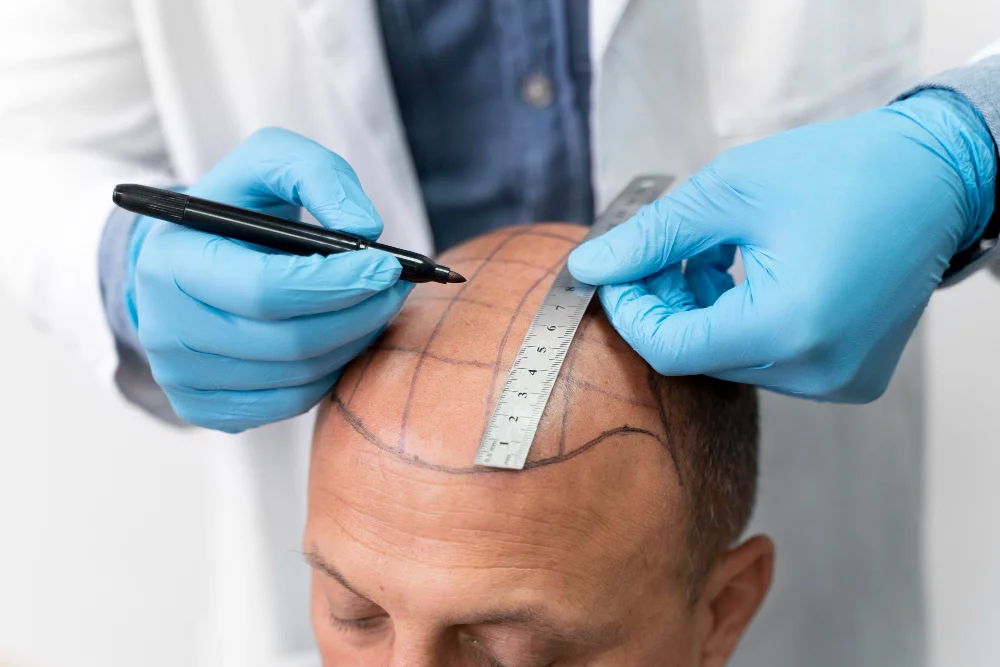
Choosing between these advanced techniques requires a thorough diagnosis of your donor area density, the elasticity of your scalp tissue, and your long-term aesthetic goals. At Stamboul Clinic in Istanbul, our surgical team evaluates your hair loss patterns using high-resolution digital trichoscopy to guide your treatment plan.
Our state-of-the-art surgical suites are equipped to perform both premium Sapphire FUE and high-precision DHI restorations under comfortable local anesthesia. We utilize top-tier materials, including custom sapphire crystal blades for clean FUE channel creation and authentic titanium-tipped Choi implanter pens for DHI placement. This dedication to quality ensures minimal tissue disturbance, gentle post-operative healing, and natural hair density.
For international patients traveling to Istanbul, Stamboul provides an all-inclusive care ecosystem, including premium hotel accommodation, private airport transfers, and dedicated multilingual patient coordination, ensuring a seamless and comfortable path to hair restoration.
Frequently Asked Questions (FAQ)
What is the primary difference between FUE and DHI?
The primary difference lies in how the hair grafts are implanted. FUE requires the surgeon to create recipient channels with a micro-blade before placing the hair with forceps, whereas DHI combines channel creation and placement into a single motion using a mechanical Choi Implanter Pen.
Is DHI better than FUE for extensive hair loss?
No. For advanced stages of hair loss requiring over 4,000 grafts, Sapphire FUE is generally preferred because it allows the surgical team to place a high volume of grafts efficiently within a safe operative timeframe.
What are the disadvantages of DHI?
The main disadvantages include a higher cost due to the intensive team support required, longer procedure times, and a lower maximum graft limit per session compared to standard FUE.
Would I look normal 10 days after an FUE hair transplant?
Yes, most patients look presentable by day 10. The micro-scabs will have washed away during recovery, leaving a clean, short buzz-cut appearance with only mild residual pinkness on the skin.
Can you combine FUE and DHI in a single session?
Yes, this combined approach is highly effective for specific patterns of hair loss. Surgeons often use Sapphire FUE to cover large balding areas on the crown and switch to DHI to build a high-density, precisely angled front hairline.
Über den Autor