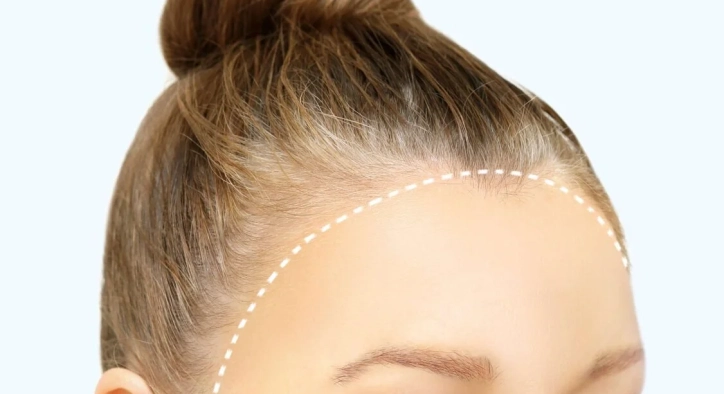
Facial aesthetics and perceived youthfulness depend on the harmonic proportion between the upper, middle, and lower facial thirds (the "Rule of Thirds"). When a naturally high forehead, genetic trait variations, or early temporal hair loss cause the anterior hairline to sit too far back, the upper face appears disproportionately dominant. This imbalance often prompts individuals to wear specific hairstyles, hide their foreheads behind heavy bangs, or feel self-conscious in windy conditions. In contemporary facial plastic surgery and hair restoration, hairline lowering provides definitive anatomical techniques to bring the hairline forward, close recessed temple angles, and balance the entire facial frame.
At Stamboul Clinic, we coordinate specialized facial plastic surgeries and advanced hair restoration procedures within fully accredited clinical hospital environments in Istanbul. Whether you are researching an all-inclusive hairline lowering Turkey medical journey, comparing hairline lowering surgery against hairline lowering fue, reviewing gender-tailored protocols for female hairline lowering and hairline lowering men, analyzing verified hairline lowering surgery before and after milestones, or assessing variable hairline lowering surgery cost determinants, this comprehensive guide delivers deep clinical insights and recovery protocols.
Table of Content
- What Is Hairline Lowering? Surgical Advancement vs. FUE Hair Grafting
- Head-to-Head Comparison: Scalp Advancement vs. FUE Hair Transplant
- Gender-Specific Architectural Design
- Hairline Lowering Surgery Before and After Milestones
- Cost Determinants: Understanding Price Variables and Estimates
- Frequently Asked Questions (FAQ)
- How is the scar hidden during a surgical forehead reduction?
- Can a surgical forehead reduction and an FUE hair transplant be combined?
- Will I experience numbness in my forehead or scalp after hairline lowering surgery?
- How do I know if my scalp is flexible enough for surgical hairline advancement?
- Why do hairline lowering costs vary between different patients?
What Is Hairline Lowering? Surgical Advancement vs. FUE Hair Grafting
To establish a clear medical foundation, let us examine the two distinct surgical approaches used to bring the hairline forward. A patient seeking hairline lowering can achieve results through either surgical forehead reduction (scalp advancement) or follicular unit extraction (hair transplant hairline lowering).
THE 2 PRIMARY CLINICAL METHODOLOGIES:
- Surgical Forehead Reduction (Scalp Advancement): Excises a strip of forehead skin and pulls the hair-bearing scalp forward in a single 2-hour surgery.
- Follicular Unit Extraction (FUE / DHI Transplant): Micro-grafts individual hair follicles into the bare forehead to build a new hairline step-by-step.
1. Surgical Forehead Reduction (Scalp Advancement Surgery)
During surgical forehead reduction, the facial plastic surgeon places a trichophytic incision along the anterior hairline border. A 1.5 to 3 cm horizontal strip of excess forehead skin is excised. The scalp is mobilized subgaleally (beneath the galea aponeurotica), advanced forward, and secured directly to the frontal bone using dissolvable cortical fixation implants (Endotine) or bone tunnel sutures. This produces an immediate 1.5 to 3 cm drop of the entire hairline in a single operative session.
2. FUE & DHI Hairline Lowering Transplant
In hairline lowering fue, individual hair follicles are extracted from the donor scalp at the back of the head and implanted into the upper forehead. This method requires no scalp incisions or bone fixation, making it the premier choice for filling recessed temporal corners, rounding masculine M-shaped patterns, or advancing hairlines in patients with low scalp laxity.
Head-to-Head Comparison: Scalp Advancement vs. FUE Hair Transplant
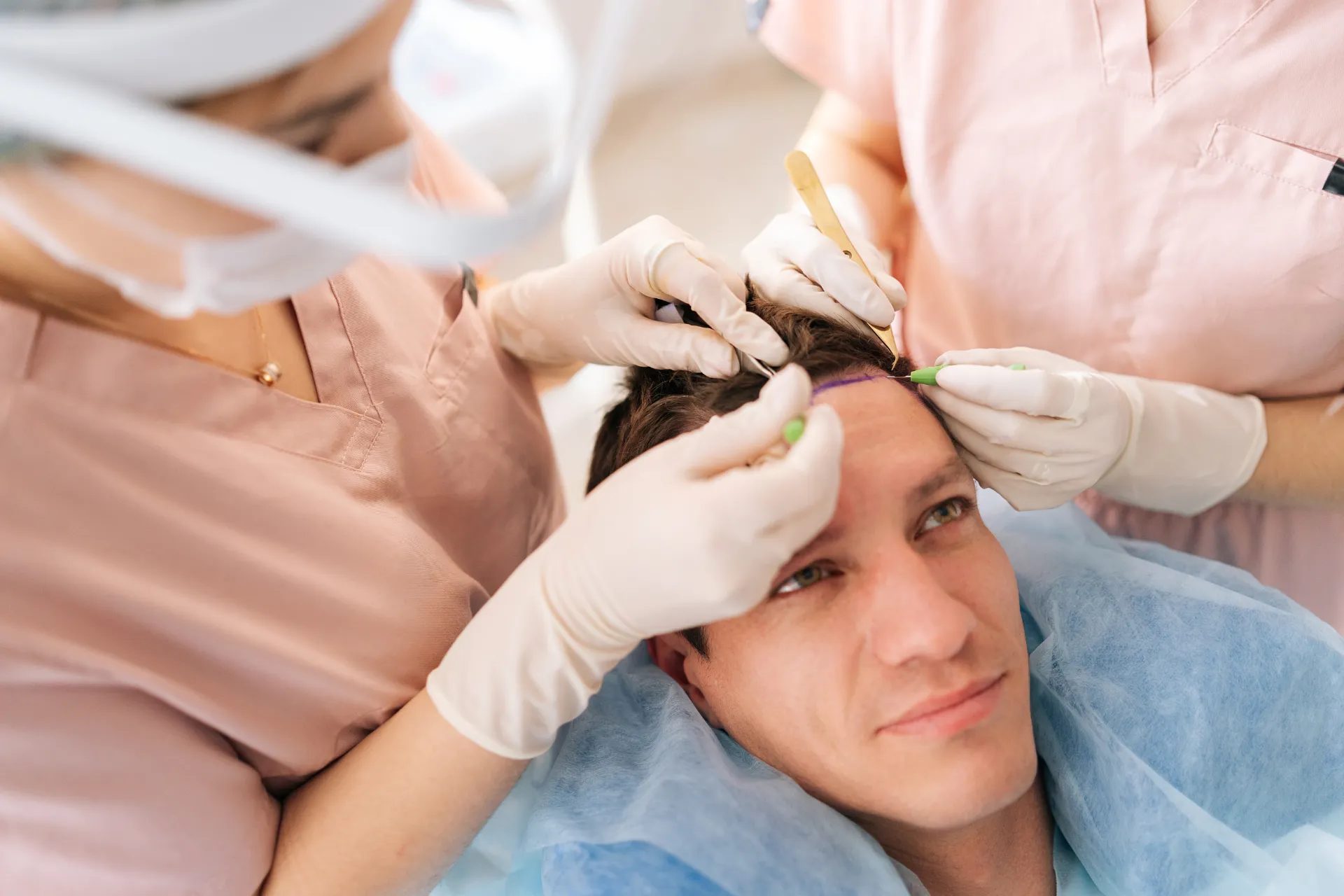
Evaluating the differences between surgical advancement and hair transplant hairline lowering clarifies which technique aligns with your scalp elasticity and aesthetic goals.
KEY CLINICAL CONTRASTS:
- Scalp Advancement: Immediate 2–3 cm lowering; requires good scalp mobility; leaves a trichophytic scar; cannot fill deep temples.
- - FUE Transplant: Gradual 9–12 month growth; ideal for low scalp mobility & temples; zero linear scars; micro-single hair design.
Clinical Parameter | Surgical Scalp Advancement | FUE / DHI Hairline Transplant |
Time to Visible Lowering | Immediate on day of surgery | Gradual growth over 6 to 12 months |
Scalp Elasticity Requirement | High (Requires flexible scalp tissue) | None (Works on tight scalp tissue) |
Temporal Angle Correction | Limited (Cannot advance lateral temples) | Exceptional (Fills any recessed temple shape) |
Incision & Scarring | Wavy trichophytic scar at hairline | Micro-puncture extraction dots (No linear scar) |
Operative Downtime | 7 to 10 days for suture removal | 3 to 5 days for initial crust shedding |
Primary Patient Demographics | Predominantly females with high hairlines | Both men with recession and women seeking density |
Gender-Specific Architectural Design
Designing a natural hairline requires understanding the biological differences between female and male facial proportions.
GENDER-SPECIFIC DESIGN PARAMETERS:
- Female Aesthetic Target: Rounded, oval, continuous forward curve without sharp temporal recessions; soft cowlick transitions.
- - Male Aesthetic Target: M-shaped or straight linear border; preserves a slight mature temporal angle to prevent feminization.
Female Hairline Lowering
Women typically seek female hairline lowering to reduce a congenital high forehead without existing hair loss. The aesthetic goal is a rounded, unbroken bell-shaped arch that softens facial contours. For surgical advancement, a trichophytic incision allows hairs to grow directly through the healing scar, rendering the incision line virtually invisible.
Hairline Lowering for Men
In hairline lowering men, designing the hairline requires caution regarding potential future androgenetic alopecia (male pattern baldness). If a male hairline is brought too low or flattened across the temples, future crown or vertex thinning can create an unnatural aesthetic. Surgeons design a mature, structured hairline using hairline lowering fue to ensure long-term harmony.
Hairline Lowering Surgery Before and After Milestones
Reviewing unedited hairline lowering surgery before and after patient profiles demonstrates how facial proportions balance when the upper third is harmonized:
THE POST-OPERATIVE RECOVERY TIMELINE:
- Surgical Advancement: Swelling peaks at days 2–3; trichophytic stitches removed at day 7–10; hair grows through scar by month 3–6.
- - FUE Transplant: Micro-scabs shed by day 10; shock loss at weeks 3–6; active permanent growth begins at months 3–4; full density at month 12.
Cost Determinants: Understanding Price Variables and Estimates

When evaluating hairline correction, prospective patients should note that pricing is individualized rather than based on a fixed rate. The overall hairline lowering surgery cost is influenced by several clinical and logistical variables:
- Selected Procedure (Surgical Advancement vs. FUE): Surgical forehead reduction requires an operating room, general anesthesia, and specialized bone fixation devices, whereas FUE/DHI transplant pricing depends on total graft count.
- Total Graft Count in FUE: Advancing a hairline by 2 cm and filling both temple peaks typically requires 1,800 to 3,000+ single- and double-hair follicular units.
- Scalp Mobility & Tissue Expander Requirement: In patients with extremely tight scalp tissue undergoing surgical advancement, a preliminary balloon tissue expander may be needed, altering surgical stages.
- Comprehensive Package Logistics: All-inclusive medical packages encompassing VIP airport transfers, hotel accommodations, and certified post-operative medical care kits shape variable pricing tiers.
Because surgical plans are customized to individual cranial anatomy, exact quotations are established following a personalized clinical evaluation. The matrix below outlines relative regional price structures for 2026:
Healthcare Destination / Region | Cost Structure & Price Variability | Relative Price Level | Typical Package Framework |
United States (USA) | High variability by surgeon & state | High | Procedure Only (Facility, Anesthesia & Checks Extra) |
United Kingdom (UK) | Variable by private clinic & hospital | High | Procedure Only (Aftercare Kits Invoiced Separately) |
Germany / Switzerland | Variable by medical fee scale (GOÄ) | Moderate to High | Procedure Only (Follow-Up Visits Invoiced Separately) |
Stamboul (Turkey) | Dynamic Custom Package | High Value / Accessible | Comprehensive (Hotel Stay, VIP Transfers & Full Care Kit) |
Frequently Asked Questions (FAQ)
How is the scar hidden during a surgical forehead reduction?
The surgeon utilizes an advanced trichophytic bevelled incision. The incision is cut at an acute angle across the hair follicles at the front of the hairline. During the healing process, native hair roots buried beneath the cut edge grow directly up through and in front of the scar tissue, camouflaging the fine line completely within the front row of hair.
Can a surgical forehead reduction and an FUE hair transplant be combined?
Yes. Combining both methods is a popular two-stage approach for patients with very high foreheads and deep temporal recession. The surgical advancement first brings the main scalp forward by 2 to 3 cm instantly; 3 to 6 months later, a small FUE session (500 to 800 grafts) is performed to fill the temporal angles and refine any subtle irregularity along the scar line.
Will I experience numbness in my forehead or scalp after hairline lowering surgery?
Temporary numbness (paresthesia) across the top of the scalp behind the incision is normal following surgical forehead reduction. As cutaneous sensory nerves regenerate through the tissue layers, normal sensation gradually returns over 3 to 9 months.
How do I know if my scalp is flexible enough for surgical hairline advancement?
During your clinical consultation, the surgeon performs a manual scalp mobility test by grasping the top of your scalp and shifting it forward toward your eyebrows. If the scalp moves 1.5 to 2.5 cm freely, you are an excellent candidate for single-stage surgical advancement. If the scalp is tight and immobile, an FUE hair transplant is the recommended path.
Why do hairline lowering costs vary between different patients?
Costs vary because every patient requires a tailored treatment plan. The choice between surgical scalp advancement under general anesthesia and an FUE/DHI transplant, the number of grafts needed to achieve natural density, and the presence of low scalp flexibility all directly influence the surgical duration and required clinical resources.
Über den Autor