

As the human face undergoes natural structural aging, deep anatomical changes extend far beyond simple skin laxity. Over time, the supportive facial ligaments weaken, allowing the malar fat pads of the midface to slide downward, creating deep nasolabial folds, fallen cheeks, pronounced marionette lines, and heavy jowls along the jawline. Traditional facelift techniques often relied on pulling the skin tightly over compromised deep structures, frequently producing an unnatural, wind-blown look with wide surgical scars. In modern facial plastic and reconstructive surgery, the deep plane facelift represents the gold standard for restoring youthful facial architecture naturally.
At Stamboul Clinic, we coordinate world-class facial plastic and reconstructive procedures within accredited, state-of-the-art surgical hospital settings. Whether you are evaluating options for a deep plane facelift turkey itinerary, seeking clarity on what is deep plane facelift technology from an anatomical standpoint, researching 1 week post op deep plane facelift scars healing milestones, or calculating global deep plane facelift cost parameters, this comprehensive clinical guide delivers deep medical insights and post-operative protocols.
Table of Content
- What Is a Deep Plane Facelift?
- Clinical Healing Milestones: 1 Week Post Op Deep Plane Facelift Scars
- The Recovery Path: Deep Plane Facelift Recovery Timeline
- Deep Plane Facelift Before and After Transformations
- Evaluating Deep Plane Facelift Cost Metrics Globally
- Frequently Asked Questions (FAQ)
- Is a deep plane facelift better than a traditional SMAS facelift?
- How do 1 week post op deep plane facelift scars look and heal?
- How long do I need to stay in Turkey after a deep plane facelift?
- How long does recovery take before I can return to public activities?
- Will I experience facial numbness or nerve risk during deep plane recovery?
What Is a Deep Plane Facelift?
To establish a clear medical foundation, let us answer a primary question: what is deep plane facelift technology from an anatomical perspective? Clinically defined as sub-SMAS composite tissue repositioning, it is an advanced surgical procedure performed under general anesthesia or deep IV sedation that targets the deep structural layers of the midface, jawline, and neck.
THE SUB-SMAS COMPOSITE REPOSITIONING SEQUENCE:
- [Sub-SMAS Dissection] ➡️ [Release of Facial Anchoring Ligaments] ➡️ [Composite Vector Elevation] ➡️ [Tension-Free Skin Closure]
Unlike traditional SMAS (Superficial Musculoaponeurotic System) facelifts that separate the skin from the muscle layer or tighten muscle independently, the deep plane technique enters the anatomical space beneath the SMAS layer. By surgically releasing the key facial anchoring ligaments (such as the zygomatic and masseteric retaining ligaments), the surgeon elevates the deep muscle structures and sagging midface fat pads as a single, undisturbed composite unit.
This composite release allows the entire midface and jawline to be repositioned upward into a youthful position without pulling or placing tension on the overlying skin. The result is a natural restoration of cheek volume, sharp jawline definition, and uncompromised structural longevity lasting up to 15 years.
Clinical Healing Milestones: 1 Week Post Op Deep Plane Facelift Scars

Evaluating incision recovery at the 7-day mark requires understanding the biological timeline of early scar maturation. Examining 1 week post op deep plane facelift scars reveals how tension-free skin closure directly influences final cosmetic outcomes.
THE 7-DAY POST-OPERATIVE INCISION SNAPSHOT:
- Incision Color & Appearance: Pink to reddish lines; slightly raised edges due to active collagen proliferation.
- Surface Scabbing & Flaking: Thin, protective micro-scabs begin to flake off naturally between days 7 and 10.
- Tissue Tension Profile: Complete absence of pull on earlobes; zero tension across surrounding skin folds.
At 1 week post-op, surgical incisions are placed discreetly along the natural anatomical borders around the ear: entering the temporal hairline, tracing the natural crease inside the tragus of the ear (retrotragal approach), curving around the earlobe, and extending into the lower hairline.
Because the deep plane technique anchors all structural weight deep beneath the SMAS layer, the skin edges are closed with zero tension. At day 7, fine superficial skin sutures are removed. While early scars appear pink or slightly raised during this initial inflammatory healing stage, tension-free closure ensures that these lines flatten into fine, nearly invisible white threads over the following 6 to 12 months.
The Recovery Path: Deep Plane Facelift Recovery Timeline
Navigating your deep plane facelift recovery with clarity ensures a smooth transition from early swelling to final contour definition.
THE CHRONOLOGICAL RECOVERY TIMELINE:
- [Days 1 – 3]: Acute Phase ➡️ Swelling and mild bruising peak; head elevated at 30–45 degrees; mild tightness.
- [Days 7 – 10]: Suture Removal ➡️ Superficial stitches removed; micro-scabs flake off; 1-week post-op scar check.
- [Weeks 2 – 3]: Social Recovery ➡️ Residual bruising fades; return to desk work and light social activities.
- [Months 3 – 6]: Final Maturation ➡️ Sub-SMAS swelling resolves; facial movements feel relaxed; contours sharpen.
During the first 72 hours, patients experience moderate facial swelling and a feeling of tightness around the cheeks and jawline as deeper tissues adapt to their elevated position. Applying cold compresses and sleeping elevated on two or three pillows minimizes fluid retention. Most patients transition to mild over-the-counter pain relief by day 3. By week 2, acute swelling subsides significantly, allowing patients to resume public activities and light desk work comfortably.
Deep Plane Facelift Before and After Transformations
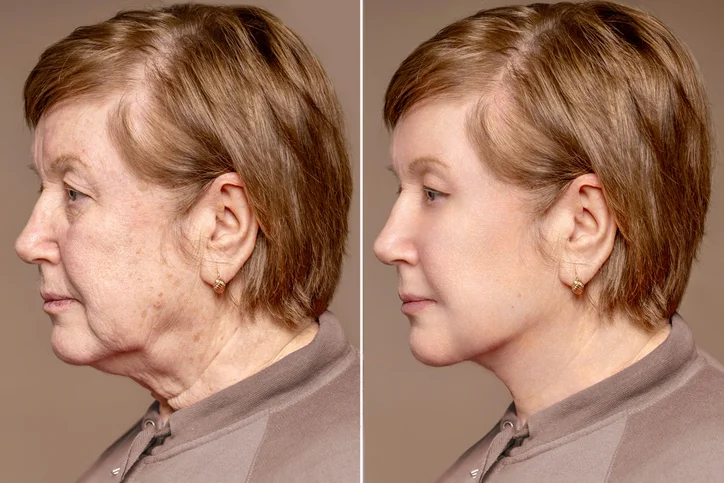
Evaluating genuine deep plane facelift before and after patient profiles illustrates how sub-SMAS composite repositioning addresses advanced facial aging:
Modern deep plane surgery completely avoids the unnatural "pulled back" appearance associated with older techniques. By releasing deep retaining ligaments, the malar fat pad is restored to its natural position on the cheekbones, automatically softening deep smile lines and restoring volume to hollow under-eye areas without requiring synthetic fillers. The jawline regains crisp, youthful definition, while combined neck lift maneuvers resolve severe neck skin laxity and vertical platysma banding.
Evaluating Deep Plane Facelift Cost Metrics Globally
A primary consideration when evaluating deep plane facial rejuvenation is the financial investment. Prospective patients routinely research the overall deep plane facelift cost or compare international private healthcare prices.
In the United States, Canada, the UK, and Western Europe, deep plane facelifts are priced as high-end reconstructive procedures due to the extreme anatomical expertise required. Surgeon fees, operating room charges, general anesthesia, and hospital facility costs push Western prices to $20,000 to $40,000+.
Selecting a deep plane facelift Turkey itinerary allows international patients to access elite, double-board-certified facial plastic surgeons within accredited hospital settings at a fraction of Western costs. The table below outlines structural pricing comparisons for 2026:
Healthcare Destination / Hub | Average Financial Investment (USD / EUR) | Included Surgical & Package Amenities |
United States (USA) | $20,000 – $40,000+ USD | Surgery Only (Facility & Anesthesia Extra) |
United Kingdom (UK) | £15,000 – £28,000 GBP | Surgery Only (Consultations & Aftercare Extra) |
Germany / Switzerland | €18,000 – €30,000 EUR | Surgery Only (Hospital & Medications Extra) |
Stamboul (Turkey) | €5,200 – €8,500 EUR | All-Inclusive (Hospital Stay, 5-Star Hotel, VIP Transfers & Aftercare) |
Frequently Asked Questions (FAQ)
Is a deep plane facelift better than a traditional SMAS facelift?
Yes, for patients with moderate to severe midface sagging and heavy jowls. While a traditional SMAS lift tightens muscle independently beneath the skin, a deep plane facelift releases deep retaining ligaments and elevates midface fat pads as a composite unit. This yields longer-lasting results (up to 15 years) and completely avoids a pulled or wind-blown look.
How do 1 week post op deep plane facelift scars look and heal?
At 1 week post-op, scars appear as thin pink or reddish lines around the ear creases and hairline. Mild swelling or minor scabbing may be present. Because the deep plane technique places zero tension on the skin edges, these incisions heal exceptionally well and fade into nearly invisible lines over 6 to 12 months.
How long do I need to stay in Turkey after a deep plane facelift?
A standard international surgical package requires a stay of 8 to 10 days in Istanbul. This allows for the surgical procedure, 1 to 2 nights of post-operative hospital observation, 1-week post-op suture removal, and a final clearance evaluation before your return flight.
How long does recovery take before I can return to public activities?
Most patients feel comfortable returning to desk work, social outings, and light daily routines 2 to 3 weeks after surgery. Residual bruising can be easily concealed with light makeup by week 2, while strenuous exercise should be avoided for 4 to 6 weeks.
Will I experience facial numbness or nerve risk during deep plane recovery?
Temporary numbness around the cheeks, jawline, and ears is a normal part of the healing process as cutaneous nerve endings recover. Because facial nerves travel beneath the deep plane layer, performing this procedure requires an expert facial plastic surgeon. When conducted by specialized surgeons, permanent nerve risk is extremely low (under 1%).
Über den Autor