Healthy gingival tissue acts as a biological seal and vascular barrier, shielding underlying alveolar bone and delicate root dentin from mechanical friction, bacterial invasion, and thermal shock. However, aggressive toothbrushing with hard bristles, untreated chronic periodontitis, anatomical thin biotypes, high frenal attachments, and past orthodontic tooth expansion can cause the gum margin to migrate apically down the root.
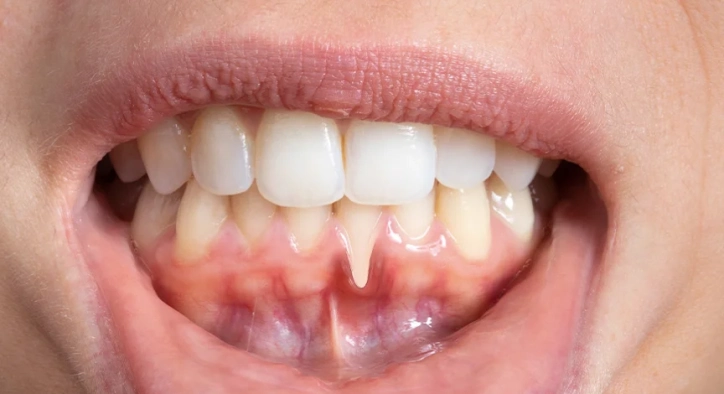
This apical migration, known clinically as gingival recession, exposes the yellowish root cementum, creating sensitive teeth, root notch wear, root caries, aesthetic elongation ("long-in-the-tooth" look), and eventual tooth mobility. Once attached keratinized gingiva is lost, it cannot regenerate through brushing adjustments, chemical mouthwashes, or toothpastes. In modern biomimetic and aesthetic periodontics, a gum graft provides the definitive microsurgical solution to reconstruct lost attached tissue, cover exposed roots, and safeguard dentition against long-term tooth loss.
Table of Content
- What Is a Gum Graft? Biology of Periodontal Soft Tissue Regeneration
- Surgical Techniques: Connective Tissue Grafts vs. Free Gingival Grafts vs. Donor Alloderm
- Donor Site Management: The Palate Healing Experience
- Recovery Timeline: Protecting the Fragile Graft Revascularization
- Visual Proof: Gum Graft Before and After Transformations
- Cost Determinants: Understanding Periodontal Pricing Variables
- Frequently Asked Questions (FAQ)
What Is a Gum Graft? Biology of Periodontal Soft Tissue Regeneration
To establish a clear medical foundation, let us examine the primary question: what is a gum graft from a periodontal and surgical perspective? Clinically categorized as periodontal plastic surgery or mucogingival reconstruction, this is an outpatient microsurgical procedure performed under local anesthesia that transfers a thin segment of healthy oral tissue, or an advanced acellular collagen dermal matrix, onto a recipient tooth bed to restore the natural gum collar.
THE MICROSURGICAL ROOT COVERAGE SEQUENCE:
[Recipient Bed Deep Debridement & Root Planing] ➡️ [Partial-Thickness Flap Elevation / Tunnel Preparation] ➡️ [Subepithelial Connective Tissue Harvesting (Palate or Allograft)] ➡️ [Micro-Suture Fixation Over Exposed Root] ➡️ [Coronally Advanced Flap Repositioning & Primary Wound Closure]
The 3 Core Anatomic Benefits
Rebuilding the missing attached gingiva accomplishes three vital clinical milestones:
- Halting Bone Resorption: Gingival recession rarely occurs in isolation; it follows underlying alveolar bone resorption. Rebuilding a wide zone of thick keratinized tissue halts progressive marginal bone breakdown.
- Eliminating Dentin Hypersensitivity: Exposed root surfaces contain open dentinal tubules that transmit cold, hot, and sweet stimuli straight to the dental pulp. Graft coverage permanently insulates these tubules.
- Aesthetic Smile Symmetry: Uneven, recessed gumlines create asymmetric tooth lengths. Grafting harmonizes the pink-and-white aesthetic balance across the anterior smile arch.
Surgical Techniques: Connective Tissue Grafts vs. Free Gingival Grafts vs. Donor Alloderm
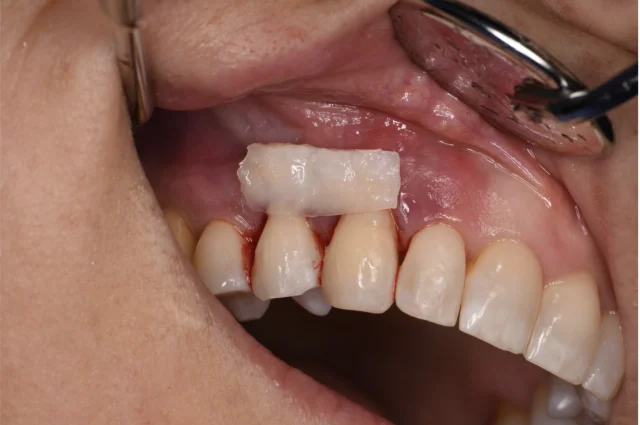
Customizing gum graft surgery depends on whether the clinical objective is root coverage, band thickening, or multi-tooth restoration without a palatal donor wound.
SURGICAL METHODOLOGIES OVERVIEW:
- Connective Tissue Graft (SCTG): Gold standard for root coverage; harvested from beneath palatal surface; blends perfectly.
- Free Gingival Graft (FGG): Harvests surface epithelium; ideal for thickening thin gum bands in non-aesthetic lower molars.
- Tunnel Technique (VISTA / Microsurgery): No vertical surface cuts; graft inserted through micro-tunnels; rapid aesthetic healing.
- Acellular Dermal Matrix (Allograft / Alloderm): Uses donor bio-collagen; eliminates palatal harvesting; ideal for full-mouth recession.
1. Subepithelial Connective Tissue Graft (SCTG)
The connective tissue graft represents the clinical gold standard for anterior aesthetic root coverage. The periodontist makes a small trap-door incision in the roof of the mouth (hard palate) to harvest only the deep subepithelial collagen matrix, closing the donor roof immediately. This graft is secured beneath a recipient flap, where it receives collateral blood supply from both the underlying bone and overlying flap. It delivers exceptional tissue blending without color mismatch.
2. Free Gingival Graft (FGG)
A free gingival graft takes both the surface epithelium and underlying lamina propria from the palate. It is primarily used on lower anterior teeth or around molars where the primary goal is not complete root coverage, but rather creating a tough, thick band of attached keratinized tissue to prevent muscles from pulling the gum down.
3. The Minimally Invasive Tunnel Technique (Pinhole / VISTA)
For patients with multiple adjacent receding teeth, modern periodontists use the microsurgical tunnel technique. Instead of creating vertical cuts across the gums, micro-instruments create a sub-periosteal tunnel beneath the intact papillae. The graft is pulled into the tunnel and secured with suspended micro-sutures. This preserves blood supply and leaves zero external scars.
Donor Site Management: The Palate Healing Experience
A major concern among prospective patients is the discomfort associated with harvesting donor tissue from the roof of the mouth.
PALATAL DONOR COMFORT PROTOCOLS:
- Single-Incision Trap-Door Technique: Keeps surface palate mucosa intact; eliminates open raw wounds.
- Custom Palatal Protection Stent: A thin, clear vacuum-formed guard protects the palate from food pressure during eating.
- Medical Cyanoacrylate & Collagen Fleece: Hemostatic bio-sponges sealed with tissue glue eliminate post-op bleeding.
With historical methods, open epithelial donor sites behaved like severe pizza burns. Today, minimally invasive single-incision harvesting leaves the overlying palatal flap intact to be sutured closed. Furthermore, wearing a custom clear plastic palatal stent acts like a smooth shield, preventing food, tongue friction, and liquids from disturbing the donor area. Most patients report that donor palate discomfort resolves within seven to ten days.
Recovery Timeline: Protecting the Fragile Graft Revascularization
The critical biological vulnerability of a gum graft lies in its revascularization phase: the transferred tissue has zero blood supply of its own and depends entirely on fragile capillary ingrowth from neighboring tissues.
THE POST-OPERATIVE RECOVERY TIMELINE:
- Days 1 to 3: Capillary Plasmatic Circulation ➡️ Graft survives on nutrient osmosis; zero brushing over site; soft cool diet.
- Days 4 to 7: Vascular Reconnection ➡️ New micro-capillaries penetrate the graft; swelling stabilizes; chlorhexidine rinses.
- Days 10 to 14: Suture Clearance ➡️ Gentle removal of micro-sutures; return to non-contact exercise; soft foods continued.
- Weeks 4 to 8: Keratinization ➡️ Graft turns firm and pink; collagen matrix matures; ultra-soft manual brushing resumed.
- Months 3 to 6: Final Tissue Maturation ➡️ Creeping attachment finishes; complete root coverage stabilized for decades.
During the initial two weeks, patients must not brush, floss, or poke the surgical recipient site. Pulling on the lip to inspect the graft can tear developing capillary loops, causing graft necrosis and failure. Instead, a prescribed chlorhexidine gluconate mouthwash cleans the area chemically.
Visual Proof: Gum Graft Before and After Transformations
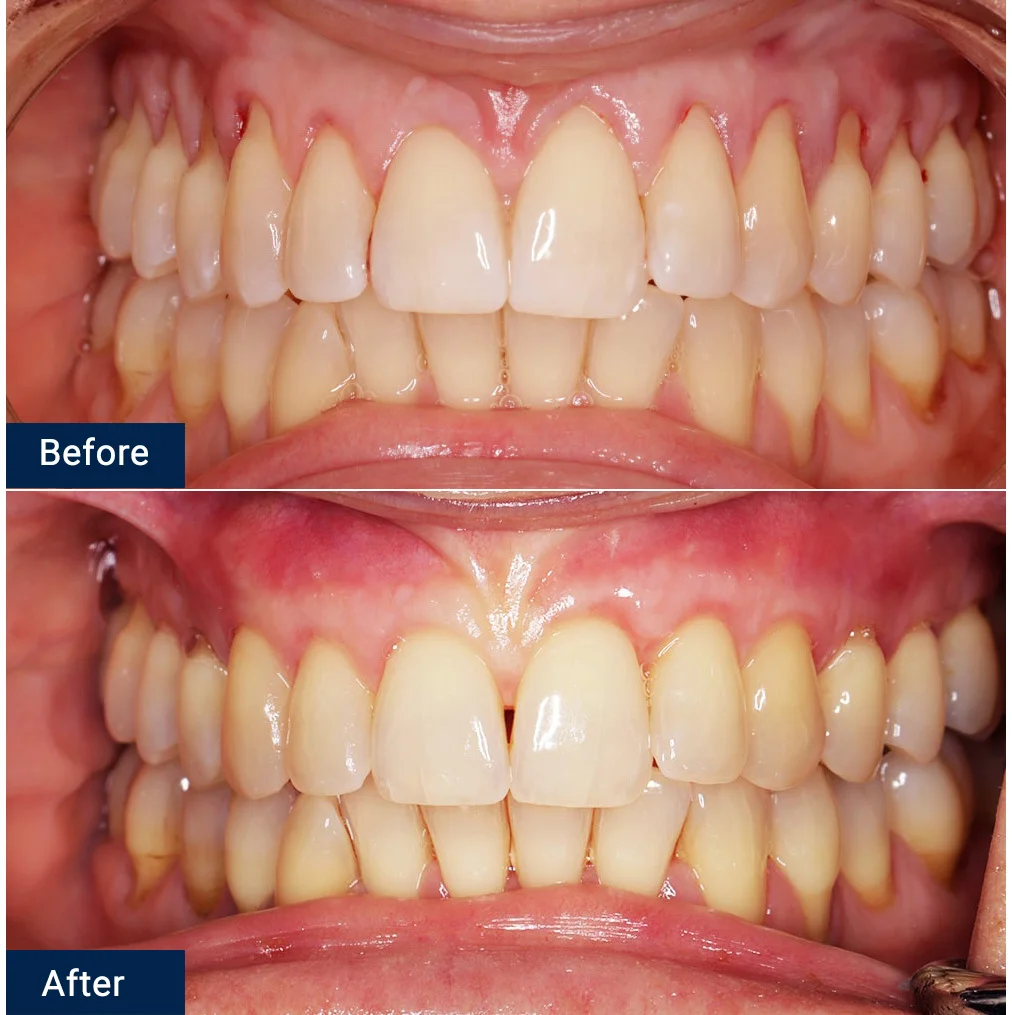
Reviewing unedited gum graft before and after photographic documentation illustrates how rebuilding attached soft tissue seals exposed roots and rejuvenates the gingival margin:
The clinical transformation covers dark, exposed yellow root surfaces, raises the gum margin into a natural scalloped arch, and thickens translucent tissue into a robust barrier that resists future recession.
Cost Determinants: Understanding Periodontal Pricing Variables
When evaluating root coverage and gingival regeneration, prospective patients should note that pricing is structured per tooth or quadrant rather than as a single fixed fee. The overall gum graft cost is shaped by several clinical and logistical variables:
- Total Number of Recessed Teeth: Grafting an isolated single lower incisor requires different clinical time and microsurgical materials than treating generalized multi-quadrant recession spanning six to twelve teeth.
- Autograft vs. Acellular Dermal Matrix (Alloderm): Utilizing donor collagen matrices (Alloderm or Geistlich Mucograft) eliminates the palatal surgical site, but incurs specialized biomaterial procurement fees compared to harvesting autologous palatal tissue.
- Surgical Complexity (Miller / Cairo Recession Classification): Class I and II recessions (intact interdental bone) allow 100% predictable coverage, whereas Class III and IV recessions (involving interproximal bone loss) require advanced regenerative membranes and enamel matrix derivatives (Emdogain), altering procedural scope.
- Microsurgical Technology & Magnification: Periodontists using high-power surgical microscopes or micro-loupes, ophthalmic-grade 7-0 micro-sutures, and tunnel instruments maintain advanced surgical overhead.
- Comprehensive Logistics: All-inclusive dental tourism packages in Turkey incorporating VIP airport transfers, hotel accommodations, 3D panoramic imaging, protective palatal stents, and specialized medication kits establish variable package tiers.
Because soft tissue architectures and bone levels are completely unique to each dental arch, exact quotations are established following a personalized clinical probe examination and 3D radiographic assessment. The matrix below outlines relative regional price structures for 2026:
Healthcare Destination / Region | Cost Structure & Price Variability | Relative Price Level | Typical Package Framework |
United States (USA) | High variability per tooth by city & specialist | Very High | Per-Tooth Surgery Only (Diagnostics, Meds & Scans Extra) |
United Kingdom (UK) | High variability per quadrant by private specialist | High | Per-Tooth Surgery Only (Consultations & Follow-Ups Invoiced Separately) |
Germany / Switzerland | Variable by dental fee scale (GOZ) & material | High | Per-Tooth Surgery Only (Biomaterials Invoiced Separately) |
Stamboul (Turkey) | Dynamic Custom Package | High Value / Accessible | Comprehensive (Multi-Tooth/Quadrant, Hotel, Transfers & Stent) |
Frequently Asked Questions (FAQ)
Can receded gums grow back naturally without surgery?
No. Gingival tissue does not possess the biological capacity to regenerate or migrate back up an exposed root on its own. While modifying your brushing technique can prevent recession from worsening, once the keratinized tissue and underlying alveolar bone are lost, surgical gum grafting is the only clinically proven method to restore lost tissue height and achieve root coverage.
Is gum graft surgery painful?
The procedure itself is performed under profound local anesthesia and is completely painless. Post-operative discomfort depends on the technique used: recipient tooth sites typically experience minimal aching, while palatal donor sites feel tender for several days (similar to a scrape). This is effectively managed with standard pain medications and a protective palatal stent. When donor allografts (Alloderm) are used, palatal harvesting is avoided entirely.
What is the success rate of a gum graft procedure?
In healthy non-smokers with intact interdental bone (Cairo Class 1 recession), the clinical success rate for complete root coverage exceeds 90% to 95%. Even in cases with mild bone loss, partial root coverage and significant thickening of the protective gum barrier are routinely achieved, halting future recession.
Can I brush my teeth after gum graft surgery?
You can brush and floss all untreated areas of your mouth normally. However, you must not touch the grafted site with a toothbrush, dental floss, or interdental brush for at least three to four weeks. During this critical vascularization window, oral hygiene at the surgical site is maintained exclusively using an antiseptic chlorhexidine mouthwash.
Why do gum graft prices vary between different patients?
Pricing varies because treatment is tailored to the individual oral condition. Factors such as the number of teeth requiring treatment, whether autologous tissue from the palate or a donor dermal matrix is selected, whether enamel matrix proteins (such as Emdogain) are applied to stimulate bone regrowth, and whether travel accommodations are bundled into international packages all shape the final cost.
Über den Autor