Dental malocclusions, rotated incisors, overlapping anterior arches, and irregular spacing affect oral functionality, periodontic longevity, and smile aesthetics. However, many adult and adolescent patients hesitate to undergo orthodontic treatment due to the visible aesthetic drawbacks, mucosal irritation, dietary restrictions, and oral hygiene hurdles associated with conventional fixed metal brackets and archwires. In contemporary digital orthodontics and biomechanical dental planning, custom clear aligners offer an aesthetic, removable, and clinically predictable alternative to traditional braces. Utilizing sequential series of medical-grade thermoplastic trays engineered from precision 3D intraoral scans, aligner systems deliver controlled physiological forces to rotate, level, and align teeth while remaining virtually invisible during routine social and professional interactions.
At Stamboul Clinic, we coordinate specialized digital orthodontic planning, interproximal reduction (IPR) protocols, and transparent aligner therapies within accredited dental facilities in Istanbul. Whether you are researching an all-inclusive dental trip to Turkey, evaluating brand systems like invisalign clear aligners, determining can clear aligners fix crowded teeth across moderate to severe classifications, comparing clinical parameters in braces vs clear aligners, analyzing verified clear aligners before and after patient profiles, or evaluating dynamic variables behind clear aligners cost, this comprehensive guide provides deep orthodontic insights.
Table of Content
- What Are Clear Aligners? Biomechanics of Sequential Orthodontic Shifting
- Clinical Capabilities: Can Clear Aligners Fix Crowded Teeth?
- Head-to-Head Comparison: Braces vs. Clear Aligners
- Daily Protocols and Treatment Duration: The Alignment Roadmap
- Visual Proof: Clear Aligners Before and After Transformations
- Cost Determinants: Understanding Aligner Pricing Variables
- Frequently Asked Questions (FAQ)
- How many hours a day must I wear my clear aligners for treatment to work?
- Can clear aligners fix an overbite, underbite, or crossbite?
- Does wearing clear aligners hurt or cause dental pain?
- Will wearing clear aligners affect my speech or give me a lisp?
- Why do clear aligner prices vary between different patients?
What Are Clear Aligners? Biomechanics of Sequential Orthodontic Shifting
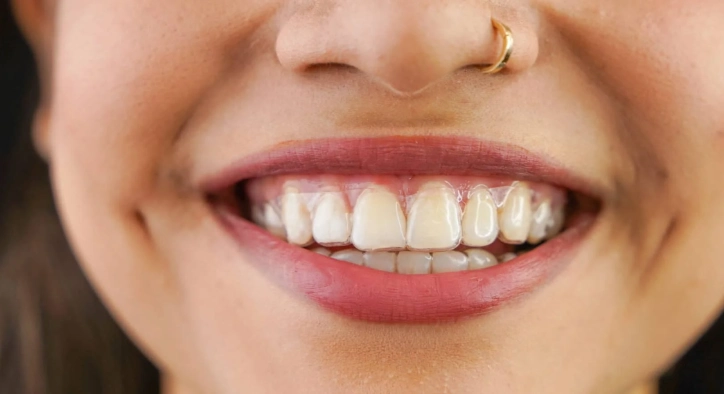
To establish a clear medical foundation, let us examine how clear aligners for teeth function from an orthodontic biomechanics perspective. Rather than pulling teeth along an archwire under continuous tension, aligners work through programmed sequential compression and tension forces delivered by vacuum-formed or 3D-printed multi-layer polyurethane or copolyester polymers.
THE DIGITAL ALIGNER WORKFLOW & FORCE SEQUENCE:
[High-Resolution 3D Optical Scan] ➡️ [Digital Staging (0.2 to 0.25 mm Movement Per Tray)] ➡️ [Composite Attachment Bonding & IPR] ➡️ [Sequential Tray Wear (20–22 Hours Daily)] ➡️ [Cellular Bone Remodeling & Final Retainer Stabilization]
The Biological Remodeling Process
Each custom tray in a sequential treatment series is manufactured with microscopic modifications, shifting target teeth between 0.2 and 0.25 millimeters per stage. When an aligner is seated over the dental arch, the slight discrepancy between the plastic geometry and the current tooth position exerts light, continuous mechanical pressure. This force compresses the periodontal ligament (PDL) on one side of the root, stimulating osteoclasts to resorb bone, while tension on the opposite side stimulates osteoblasts to deposit new alveolar bone, allowing safe biological tooth translation.
The Role of SmartForce Composite Attachments
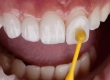
Orthodontic aligners require grip surfaces to execute complex movements, particularly on smooth or conical premolars and canines. To achieve this, the orthodontist bonds small, tooth-colored composite resin shapes (attachments) directly onto specific tooth surfaces. These attachments act as mechanical handles that engage with custom-formed indentations in the aligner plastic, directing force vectors for root torque, bodily translation, and vertical extrusion.
Clinical Capabilities: Can Clear Aligners Fix Crowded Teeth?

A common question among patients considering aesthetic orthodontics is: can clear aligners fix crowded teeth predictably?
ALIGNER MALOCCLUSION CAPABILITY MATRIX:
- Mild Crowding (1 to 3 mm overlap): Readily resolved within 3 to 6 months through arch expansion and tipping.
- Moderate Crowding (4 to 7 mm overlap): Successfully corrected using engineered attachments, IPR, and sequential distalization.
- Severe Crowding (>8 mm overlap / Skeletal issues): Requires complex multi-stage mechanics, auxiliary elastics, or preliminary extractions.
The clinical answer to can clear aligners fix crowded teeth is yes, for the vast majority of dental crowding cases. Orthodontists utilize three primary techniques to create space for overlapping anterior teeth without extractions:
- Dental Arch Expansion: Moving posterior premolars and molars slightly outward laterally, widening the dental arch to accommodate crowded anterior incisors.
- Interproximal Reduction (IPR): Polishing fractions of a millimeter (typically 0.2 to 0.5 mm) from the outer enamel borders between crowded contact points, creating clearance for teeth to untwist without damaging tooth vitality.
- Sequential Distalization: Moving molar teeth incrementally backward into empty arch space to unlock crowded front teeth.
Head-to-Head Comparison: Braces vs. Clear Aligners
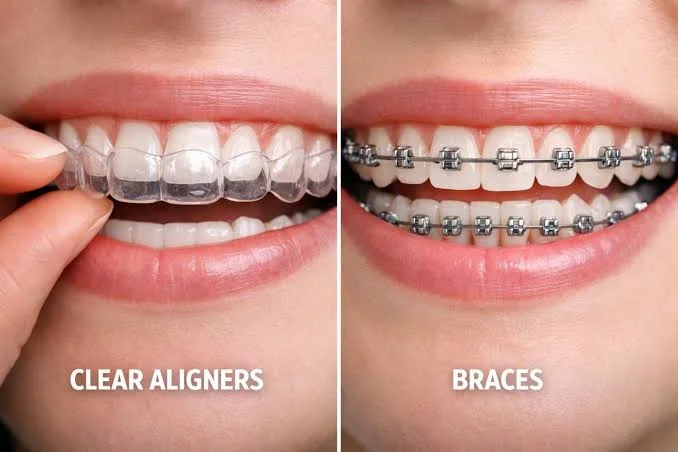
Evaluating the parameters of braces vs clear aligners clarifies which orthodontic system matches your lifestyle, aesthetic requirements, and malocclusion complexity.
ORTHODONTIC SYSTEM CONTRASTS:
- Clear Aligners: Virtually invisible; removable for eating and oral hygiene; zero dietary limits; compliance-dependent (22 hrs/day).
- Fixed Metal/Ceramic Braces: Fixed to teeth 24/7; non-compliance-dependent; handles severe skeletal discrepancies; dietary restrictions.
Clinical Parameter | Clear Aligners (Invisalign / Advanced Systems) | Traditional Fixed Braces (Metal / Ceramic) |
Aesthetic Visibility | Virtually invisible (Clear medical polymer) | Highly noticeable (Metal or ceramic brackets & wires) |
Removability | Removable for meals, brushing, and flossing | Non-removable (Fixed to teeth throughout treatment) |
Daily Compliance Required | Strict 20 to 22 hours per day | Passive compliance (Works continuously 24/7) |
Dietary Restrictions | None (Trays removed during eating) | Extensive (No hard, sticky, or crunchy foods) |
Oral Hygiene & Flossing | Normal brushing and unrestricted flossing | Specialized threaders and interdental brushes required |
Soft Tissue Irritation | Minimal (Smooth laser-trimmed plastic edges) | Moderate to high (Bracket cuts, wire pokes, wax needed) |
Average Treatment Duration | 6 to 18 months depending on complexity | 12 to 24 months |
Daily Protocols and Treatment Duration: The Alignment Roadmap
Aligner success is directly proportional to patient discipline. Unlike fixed appliances that remain permanently attached, aligners place responsibility for treatment tracking directly on the patient.
THE CHRONOLOGICAL ALIGNER TIMELINE:
- Daily Routine: Trays worn 20 to 22 hours per day; removed only for meals, hot drinks, and brushing.
- Tray Change Intervals: Sequential aligners changed every 7 to 14 days based on biological tooth tracking.
- Clinical Checkpoints: Orthodontic monitoring every 6 to 8 weeks to assess tracking, perform planned IPR, and supply new trays.
- Refinement Phase: Additional micro-adjustment trays (3 to 8 aligners) printed to fine-tune final micro-rotations.
- Lifelong Retention: Custom Vivera or Essix clear retainers worn at night to prevent post-orthodontic relapse.
Patients must clean trays using lukewarm water and gentle antibacterial cleansing crystals, avoiding boiling water, which warps thermoplastic geometry. Wearing aligners for fewer than 20 hours daily delays tooth movement, leading to "tracking loss" where teeth fail to fit within the plastic molds, necessitating mid-course digital corrections.
Visual Proof: Clear Aligners Before and After Transformations
Reviewing unedited clear aligners before and after clinical photographic records illustrates how sequential aligner therapy resolves anterior crowding, deep bites, and midline shifts:
The final outcome showcases aligned dental arches, balanced interproximal contacts, and an uncrowded smile line that preserves tooth enamel and promotes healthy periodontal tissue.
Cost Determinants: Understanding Aligner Pricing Variables
When evaluating orthodontic alignment, prospective patients should note that fees are customized based on clinical complexity and case classification rather than a single fixed rate. The overall clear aligners cost is influenced by several clinical and logistical variables:
- Severity of Malocclusion & Tray Count: A simple aesthetic correction involving minor crowding requires fewer aligners (e.g., Express or Lite packages of 7 to 14 trays), whereas comprehensive correction of moderate-to-severe crowding, bite misalignment, or extraction spaces requires a Comprehensive package (25 to 50+ trays).
- System Brand & Software Engineering: Proprietary global systems like invisalign clear aligners utilize patented multilayer SmartTrack materials and specialized biomechanical ClinCheck planning algorithms, reflecting specialized licensing overhead compared to local in-house aligner brands.
- Pre-Orthodontic Dental Preparations: Required pre-treatments, such as ultrasonic scaling, cavity restorations, wisdom tooth extractions to create posterior space, or laser gingival leveling, influence the total care plan.
- Refinement Trays & Retention Packages: Comprehensive plans that include digital mid-course refinements and durable lifelong retainers (such as Vivera retainers) provide lasting clinical stability.
- Comprehensive Logistics: All-inclusive dental tourism packages in Turkey incorporating VIP airport transfers, hotel accommodations, digital 3D scans, and full treatment monitoring create variable pricing tiers.
Because treatment plans are customized to individual dental arch geometry, exact quotations are established following a personalized clinical evaluation and 3D digital simulation. The matrix below outlines relative regional price structures for 2026:
Healthcare Destination / Region | Cost Structure & Price Variability | Relative Price Level | Typical Package Framework |
United States (USA) | High variability by complexity & provider | Very High | Full Treatment Only (Consultations & Retainers Extra) |
United Kingdom (UK) | Variable by private clinic & tray tier | High | Treatment Only (Refinement Scans Invoiced Separately) |
Germany / Switzerland | Variable by dental fee scale (GOZ) | High | Treatment Only (Checkup Visits & Retainers Extra) |
Stamboul (Turkey) | Dynamic Custom Package | High Value / Accessible | Comprehensive (Full Trays, Hotel, Transfers & Retainers) |
Frequently Asked Questions (FAQ)
How many hours a day must I wear my clear aligners for treatment to work?
You must wear your clear aligners for 20 to 22 hours every single day. Trays should be removed only for eating meals, drinking anything other than plain cool water, and performing your daily brushing and flossing routines. Wearing aligners for fewer than 20 hours slows cellular bone remodeling, causes tracking failure, and lengthens overall treatment time.
Can clear aligners fix an overbite, underbite, or crossbite?
Yes. Modern clear aligner systems utilize engineered composite attachments, inter-arch elastic bands, and bite ramps to correct Class II (overbite), Class III (underbite), and crossbite malocclusions. While severe skeletal jaw discrepancies may require orthognathic surgery or preliminary fixed appliances, dental bite misalignments are routinely managed with aligners.
Does wearing clear aligners hurt or cause dental pain?
Clear aligners do not cause the sharp cuts, wire pricks, or mouth ulcers common with metal braces. However, when switching to a new set of trays every 7 to 14 days, you will experience mild pressure, tightness, and tenderness for the first 24 to 48 hours. This sensation is normal and indicates that orthodontic force is actively initiating biological tooth movement.
Will wearing clear aligners affect my speech or give me a lisp?
You may notice a minor, temporary lisp for the first 2 to 4 days as your tongue adjusts to the thickness of the plastic along the interior surface of your upper front teeth. Reading aloud or practicing speaking during the first 48 hours helps your tongue adapt quickly, after which normal speech patterns return completely.
Why do clear aligner prices vary between different patients?
Pricing varies because every smile presents unique anatomical requirements. Factors such as whether your crowding requires a minor 10-tray aesthetic touch-up or a comprehensive 40-tray correction of both arches, whether interproximal reduction (IPR) and attachments are needed, and whether international hotel and transfer services are included all directly determine procedural duration and total package cost.
Über den Autor